Systems that bend before they break.
Foresight-Redundancy (FR) is a lightweight reliability layer that sits on top of the data you already collect and measures how close a system is to becoming expensive or unreliable.
Operations teams are buried in dashboards, thresholds, and alarms. What they really need to know isn’t “Is this number high right now?” but “How long can I trust this system before it becomes expensive?” FR answers this by measuring a system’s temporal horizon—how far ahead its behavior remains predictable before uncertainty (and cost) begins to rise.
A simple traffic-light view
FR compresses the horizon into an easy status that operators and technicians can act on quickly:
- GREEN – Stable. Horizon is long; the system behaves as expected. No immediate action needed.
- YELLOW – Watch. Horizon is shortening; verify readings, plan maintenance, or schedule a closer look.
- RED – Act. Horizon has collapsed; the system can no longer “see its future.” Time to adjust, clean, or replace before the next failure or complaint.
How FR works
FR fits a small forecasting model onto your live or historical readings and asks a simple question:
“How far ahead does this signal remain predictable before the error grows too large?”
When the horizon is long, the system is stable and cheap to ignore. When the horizon begins to shrink, risk and cost are quietly rising. Once the horizon collapses, the system has effectively lost its future— it’s time to intervene.
FR doesn’t try to explain why something is drifting (that’s the technician’s job). It quantifies how close you are to trouble, using the data you already collect.
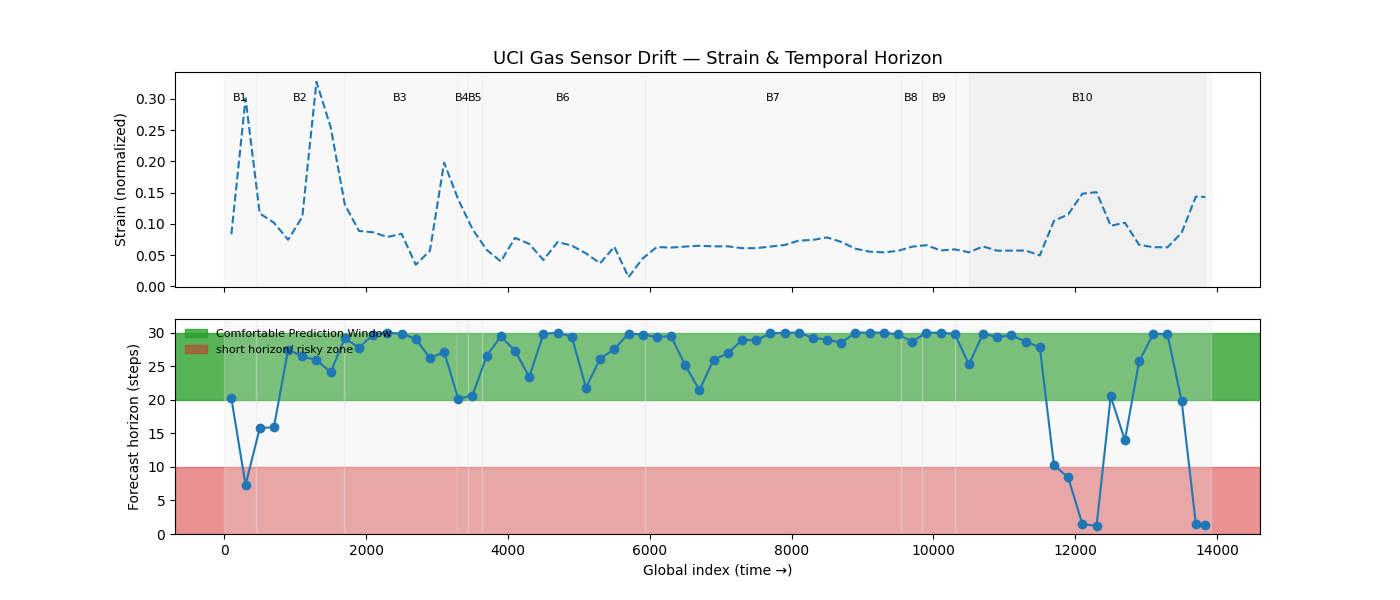
Example: sensor drift & warning window
In many systems, raw readings stay inside a “normal” range even as behavior degrades. The graph below illustrates an example where the sensor looks acceptable to the naked eye, but the horizon tells a different story:
Example: Wi-Fi collapse & horizon
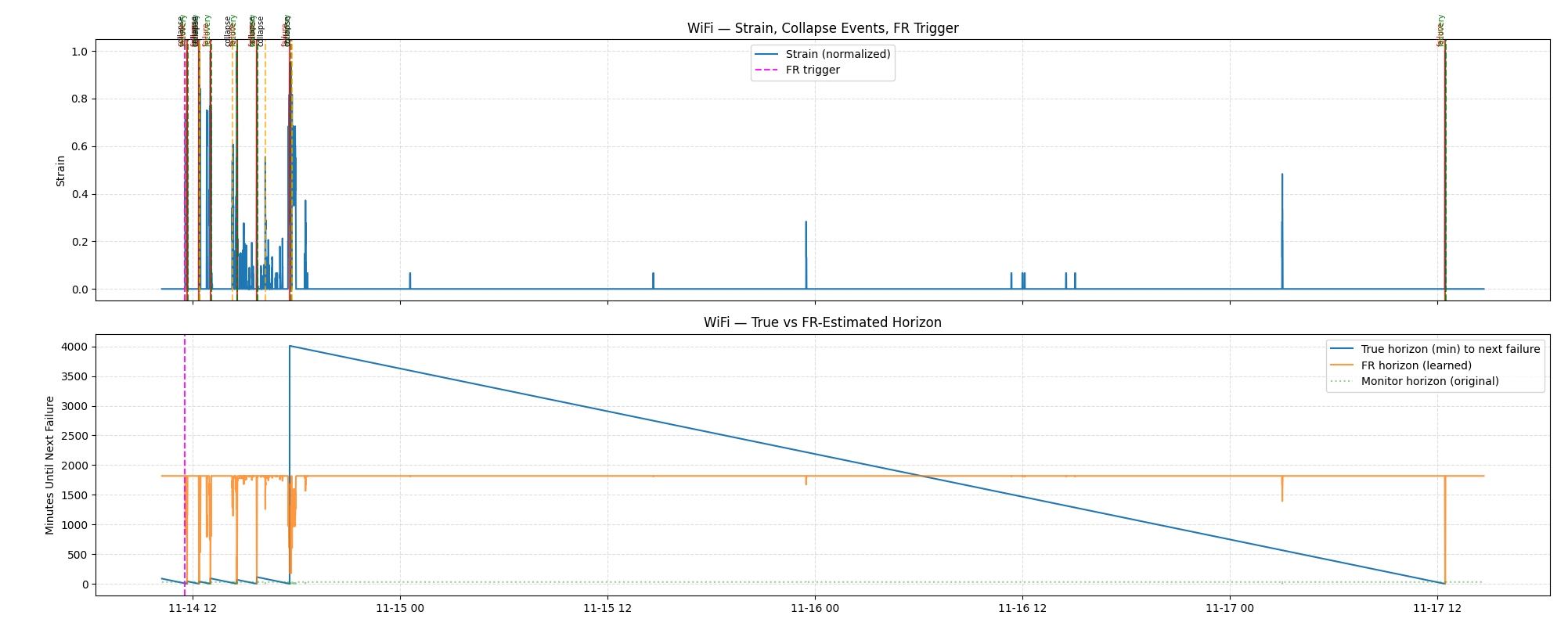
From the signal alone, a Wi-Fi link can look noisy but “not catastrophic.” To operators, the first sign of trouble is often a user complaint or a string of reconnects.
FR looks at the same data and measures how much future is left in the signal. In this example, the horizon drops to nearly zero hours before the first complaint arrives.
Where Foresight-Redundancy helps
FR is designed for any environment where you already log data, failures are costly, and equipment “slowly gets worse” before it breaks. Some natural fits:
- Building Automation / HVAC — Detect drifting temperature, humidity, or pressure sensors; spot unstable loops and equipment strain before callbacks.
- Greenhouse Operations — Catch drifting humidity or EC probes before they mislead the climate computer and harm a crop.
- Industrial & Manufacturing — Watch pumps, fans, compressors, or critical circuits for rising strain instead of waiting for hard trips.
- Solar & Energy Systems — Distinguish weather-driven variability from true hardware degradation; avoid unnecessary truck rolls.
- Water / Wastewater — Identify unstable pumps and valves before standard alarms trigger or operators see visible problems.
- Any logged system — If you have trend logs for a system that “gradually gets worse”, FR can likely model its strain.
What FR delivers
Compared to traditional alarm and dashboard setups, FR is built to provide:
- Earlier warnings than simple threshold-based alarms
- Fewer nuisance alerts than naive anomaly detection
- A clear, economic “should we act now?” trigger for intervention
- Visuals that help technicians see when the system started to bend
FR doesn’t replace your existing monitoring. It adds a narrow layer of foresight that helps you decide when to pay attention.
Start with your data
I’m currently running small pilot projects with teams who want clearer reliability insight and fewer false alarms — using the data they already collect.
If you have trend logs or historical CSV data from:
- an AHU / RTU / VAV,
- a greenhouse zone,
- a production pump or fan,
- or a misbehaving circuit,
you can start there. Send a CSV export (about a week of data is enough for a first look), and I’ll send back a Foresight Report highlighting:
- where the system’s horizon began to shorten, and
- when you would have wanted to intervene.
No installs. No agents. Just your existing data.
Email: bruce@firesmith.ca